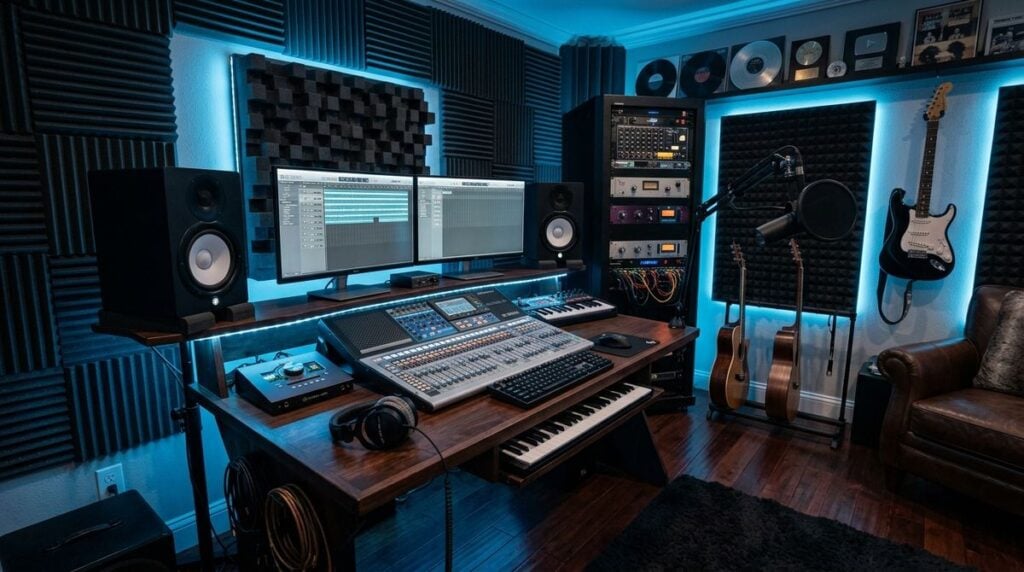

Modern gaming and virtual environments have outgrown standard stereo panning. Players and virtual reality users expect acoustic spaces that mirror physical reality, where sounds reflect off simulated walls, adjust smoothly with head movement, and convey accurate distance cues. Launching a specialized spatial audio studio provides sound designers, audio engineers, and music producers with an exciting pathway into next-generation entertainment development. This growing demand opens up viable commercial opportunities for independent sound teams.
Unlike conventional audio suites that master exclusively for headphones or stereo speaker pairs, a spatial audio enterprise designs dynamic, three-dimensional acoustic fields. These specialized sound environments serve video game studios, extended reality developers, and virtual world creators who require advanced acoustic realism to keep audiences fully immersed.
Understanding the Shift Toward Immersive Sound
Interactive entertainment requires a fundamental rethink of how audio assets are created and implemented. Traditional production relies on fixed channel layouts, but immersive virtual spaces require object-based audio and ambisonic sound fields. When an audio studio builds assets as discrete objects positioned in three-dimensional space, the playback engine calculates volume, filtering, and delay in real time based on player position.
In linear mediums such as film and music recording, an engineer crafts a single perspective that remains identical during every playback. In contrast, interactive spaces demand a responsive soundscape that reacts continuously to user decisions. A virtual player might crouch, pivot rapidly, or walk behind an obstacle, requiring sound sources to muffle and shift dynamically. Mastering this non-linear workflow separates a dedicated spatial studio from traditional audio post-production facilities.
This technical evolution presents a distinct business opportunity for audio professionals. Game studios frequently lack the in-house bandwidth or specialized acoustic knowledge required to handle binaural rendering, early reflection simulation, and occlusion modeling. By establishing a dedicated studio focused on these complex spatial tasks, you position your venture as an indispensable partner for interactive creators.
Identifying Lucrative Niches in Virtual Sound Design
Virtual worlds encompass a wide variety of interactive projects, ranging from sprawling open-world role-playing games to immersive training simulations and virtual music venues. Identifying your studio’s primary focus early helps you allocate equipment, organize sound libraries, and tailor your portfolio toward the most viable commercial sectors. Evaluating these different avenues ensures your early marketing efforts target developers whose production values align with your studio capabilities.
Commercial viability depends on staying alert to broader commercial developments and industry movements. Entrepreneurs who monitor platform shifts through platforms like LIT Market can spot emerging opportunities across digital entertainment ecosystems before traditional studios react. Keeping an eye on how various commercial sectors invest in interactive tech helps you direct your business development toward funded sectors.
Focusing on a specific technical specialty also helps differentiate your studio. For example, some studios focus on acoustic modeling for architectural walkthroughs and virtual reality experiences, while others specialize in dynamic combat audio for multiplayer online games. Choosing a well-defined specialty establishes your reputation as a go-to authority rather than a generalist sound provider.
Building an Adaptable Technical Pipeline
Establishing an immersive sound facility requires balancing hardware investment with robust software workflows. Rather than spending capital on oversized mixing consoles, a spatial audio studio prioritizes powerful processing workstations, calibrated multi-channel speaker setups, and high-fidelity head-tracking monitoring systems. Your monitoring environment must translate accurately across both specialized spatial speaker arrays and consumer headphones running binaural decoding.
Much like the structured technical protocols needed when managing an esports broadcast audio company, setting up a spatial sound pipeline requires rigorous asset management and consistent testing standards. Without tight organizational habits, complex interactive sessions with hundreds of dynamic audio objects can quickly become unmanageable.
Your production pipeline should center around several key components:
- High-resolution field recording gear capable of capturing ambisonic and multi-channel impulse responses
- Digital audio workstations configured for object-based spatial panning and multi-channel routing
- Dedicated middleware authoring tools that communicate smoothly with leading interactive game engines
- Calibrated head-tracking headphones to verify binaural positioning and frequency response
Integrating your audio assets directly into middleware simplifies delivery for client teams. Game developers appreciate audio partners who test their own assets directly within game builds, verifying that sound attenuation curves, occlusion layers, and reverb zones behave correctly before final sign-off.
Attracting High-Value Game and Virtual World Clients
Finding steady contract work requires a deliberate marketing plan focused on game directors, development leads, and technical producers. Many audio studios make the mistake of creating passive demo reels that show audio waveforms or static sound redesigns. In the interactive space, prospective clients want to see your sound assets functioning inside playable prototypes or real-time simulation builds.
Building a steady pipeline of commercial engagements takes structured business development habits. Utilizing client-generation resources such as Startup Cradles can help independent creative studios streamline their outreach and secure commercial partnerships with expanding enterprises. Combining targeted client acquisition strategies with interactive audio demos ensures your studio remains visible to active project commissioners.
When presenting your work, create concise screen captures that display your audio running inside an interactive engine alongside the visual action. Demonstrating how a sound changes when an avatar moves through varying simulated spaces proves your technical competence immediately. Game developers appreciate seeing that you understand technical implementation rather than merely creating aesthetic soundscapes in isolation.
Managing Production Timelines and Studio Growth
Working on interactive games and virtual spaces requires flexible project management. Unlike traditional album production or film scoring, game development schedules often shift as mechanics are refined, levels are redesigned, and software updates are deployed. Your studio contracts should clearly define delivery milestones, revision cycles, and technical integration requirements to prevent scope creep.
Clear communication regarding audio budgets and memory limits is equally critical. Virtual worlds operate under strict computational constraints, meaning your spatial audio systems must deliver compelling immersion without overloading client hardware. Demonstrating an understanding of optimization keeps technical directors happy and leads to repeat business. Collaborating early with programmers ensures that dynamic audio parameters are properly budgeted and profiled throughout development.
As your project roster expands, consider bringing on specialized contractors such as middleware scripters or field recording assistants. Scaling your operations steadily allows you to undertake larger virtual world contracts while preserving the high sonic standards that define your brand.